 KOREAN
 CHINESE

Human Rights Center
- Home
- Students Life
- Human Rights Center
Human Rights Center
Human Rights Center
The Human Rights Center has a human rights counseling office and a gender equality counseling office to consult on sexual harassment, sexual violence and human rights violations, to petition and investigate damage, to protect victims, to solve fair problems and prevent recurrence. In addition, we would like to prevent human rights violations including sexual harassment and sexual violence through active preventive education, and conduct related academic research and fact-finding surveys to improve the human rights sensitivity of members.
- Location: Woosong University West Campus, Student Welfare Center(W16) 3rd Floor, Human Rights Center
- TEL: 042-630-9900
- eMail: humanrights@wsu.ac.kr
- Operating hours: 09:00 to 18:00 (excluding lunch hours and holidays)
What are human rights?
Human rights are the most basic rights that a person has as a person and are inherent rights that everyone has since birth. Human rights are free and equal in dignity and rights, regardless of race, nationality, gender, religion, political opinion, identity or status. Therefore, no one can deprive others of their human rights and all these rights are interdependent and inextricably linked.
According to Article 10 of the Constitution of the Republic of Korea, "All citizens have dignity and value as human beings, and have the right to pursue happiness. The state has an obligation to identify and guarantee the basic inviolable human rights of individuals.", and Article 37 below stipulates the right to equality, freedom, suffrage, social rights, and claims.
What is a human rights violation?
It refers to violating the minimum basic rights that must be guaranteed in order to realize dignity as a human being due to gender, nationality, disability, position, and other reasons.
Types of human rights violations
1. Human rights violations caused by discrimination
- Discriminatory acts on the grounds of gender, age, gender identity, marital status, physical conditions, etc
- discrimination based on religious, ideological or political opinions
- Discriminatory acts on the grounds of social status, educational background, disability, family situation, medical history, etc
- Discriminatory acts based on the region of origin, country of origin, ethnicity, and skin color
2. Human rights violations that do not guarantee freedom
- the act of interfering in privacy, communication, and personal information
- an act of restricting one's right to act according to religion, belief, or conscience and express one's opinion freely
- Freedom of assembly and association, and the act of restricting the right to vote and the right to run for election
- an act of disregarding procedural rights in disciplinary actions
3. Human rights violations caused by violence
- acts of physical violence, such as defiance, corporal punishment, harshness, beating, etc
- Acts of inflicting verbal violence, such as verbal abuse, abusive language, insults, etc
- the act of forcing people to drink or not to go home at a drinking party
4. Human rights violations that do not guarantee the right to education and labor
- an act that violates the right to education safely and appropriately
- The act of not paying due labor or paying less than the minimum wage
What is sexual harassment/sexual violence
Sexual harassment' is a problem arising from hierarchical order or inequality of power, and is a sexual harassment if it unilaterally causes sexual humiliation or disgust to the other party due to words or actions containing sexual implications without the consent of the other party, and if the other party is penalized for not following sexual behavior or other sexual demands.
Types of sexual harassment
- Physical sexual harassment: The act of causing sexual humiliation or disgust to the victim by physically contacting or touching a specific body part regardless of the other person's intention
- Verbal sexual harassment: The act of saying obscene and vulgar things, making sexual metaphors or evaluations of appearance, or burying or disseminating sexual privacy regardless of the other person's intention
- Visual sexual harassment: Acts that cause sexual disgust or discomfort through actions that can be recognized with the eyes regardless of the other person's intention
- Other sexual harassment: A language or behavior that is conventionally recognized as causing sexual humiliation or disgust
Dating violence
Violence that occurs physically, emotionally, verbally, economically, and sexually in a relationship with a lover or a person, and includes the act of monitoring or controlling the behavior of the other person through direct or indirect violence.
- Stalking: An act of causing anxiety or fear in the other party by persist ently bullying him/her mentally/physically by intentionally chasing him/her against the other party's will without justifiable reasons
- Cyber Sexual Violence: Acts of threatening or harassing the other party in connection with sexual matters on the Internet, including the delivery of obscene messages and the dissemination of obscene materials
What you must know to prevent sexual harassment and sexual violence
- I have the right to be guaranteed sexual self-determination.
- Trust your feelings.
- Be clear and firm and confident.
- Silence is not an agreement.
- You must respect the will of others.
- It is recommended to drink alcohol only within the control range.
- Have a value for your sex, a standard for the limits of your behavior.
How to apply for counseling to the Human Rights Center
1. An application for a visit
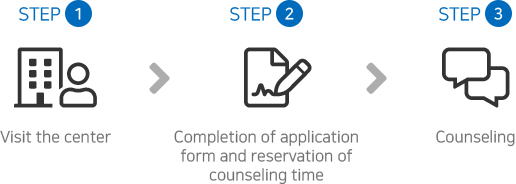
Center location: Human rights center on the 3rd floor of the Student Center (W16)
※ If you make a reservation in advance when applying for a visit, the application will be made smoothly.
2. Phone application
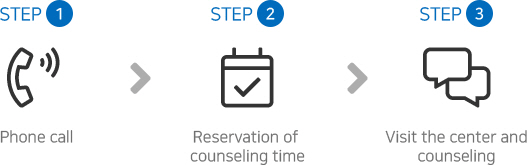
Phone number: 042-630-9900
3. Email application
E-mail : humanrights@wsu.ac.kr
Connect with Woosong
Contact Us
Get in touch with our team